


Open Monument Day at Heinfels Castle: Archaeological Discoveries from Before the Castle's Time
Great interest in Open Monument Day at Heinfels Castle: In four presentations, archaeologist Harald Stadler took visitors on a journey through several millennia – from the Stone Age to the Early Middle Ages. Just how old is the castle hill at Heinfels? Who inhabited this site long before the medieval castle was built? And what stories can archaeological finds reveal about its past?
This year's Open Monument Day at Heinfels Castle explored these very questions. All four presentations by archaeologist Harald Stadler were very well attended. The audience was diverse, ranging from children and young people to adults with a keen interest in history.
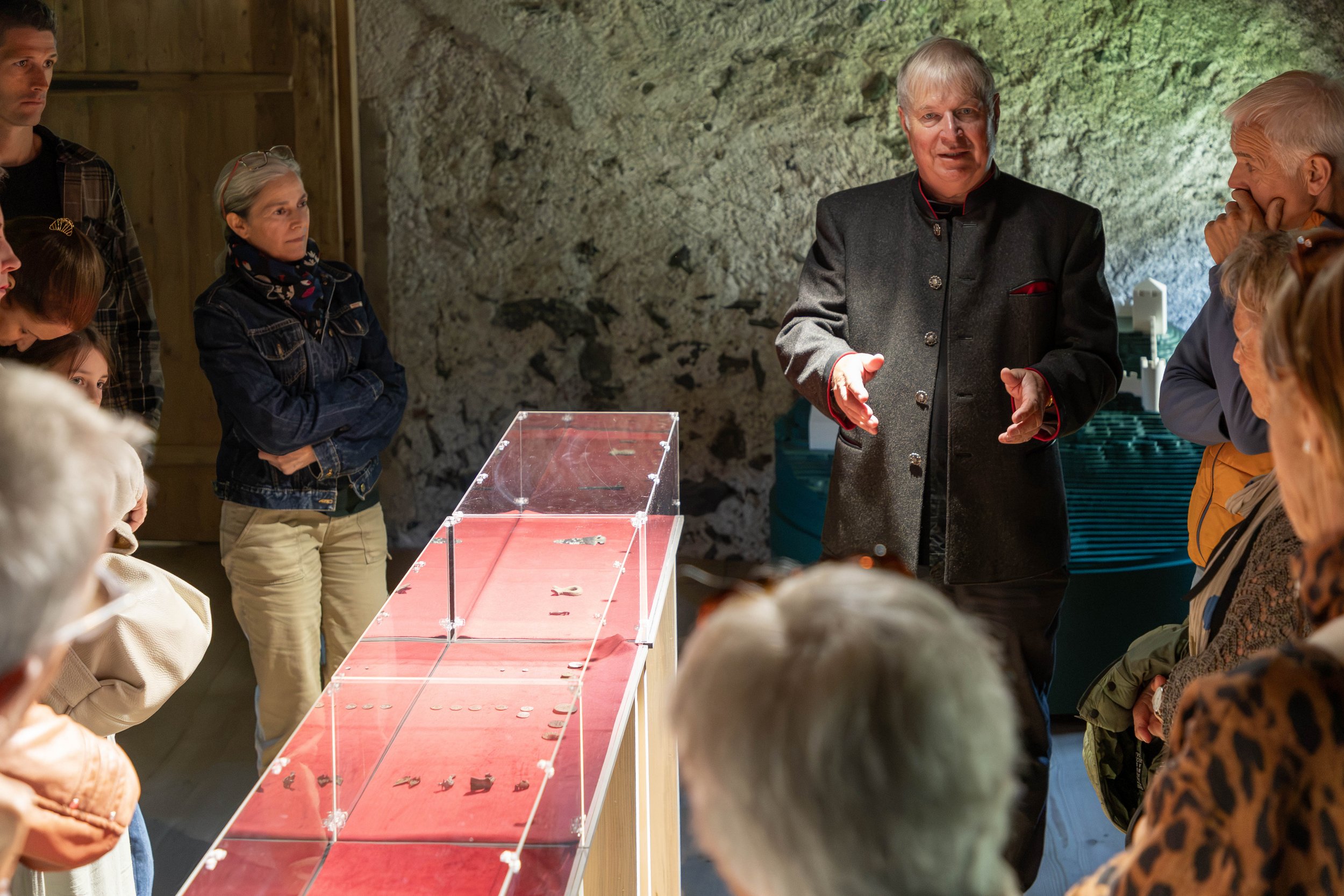
Newly discovered archaeological finds were presented to the public for the first time.
First-hand insights into archaeology
Harald Stadler proved to be the ideal expert for the occasion. An archaeologist and Professor Emeritus at the University of Innsbruck, he has spent decades researching the prehistoric and early historic periods as well as medieval archaeology in East Tyrol. His connection with Heinfels Castle also goes back a long way: as early as 1993, Stadler was involved in the first systematic archaeological excavations in the keep. Alongside findings relating to the castle's architectural history, traces of earlier settlement were also discovered.
On Open Monument Day, Stadler presented the history of the castle hill in a concise, engaging and highly illustrative lecture. From the Neolithic period through the Bronze and Iron Ages, the Celts and the Roman era to the Early Middle Ages, he painted a picture of a place that had been inhabited and shaped by people for thousands of years before the castle was built.
New discoveries are reshaping our understanding of the castle hill
An important role in this research is played by the Archaeological Research Group of East Tyrol (Archäologische Forschungsgruppe Osttirol), chaired by Harald Stadler. Since 2021, the group has been conducting systematic surveys using metal detectors on the castle hill and within the castle grounds. Hundreds of objects have already been discovered, spanning a period from the Bronze Age to the 20th century.
Metal detector enthusiasts such as Michael Jost, Lukas and Andreas Kratzer, and Thomas Mitterdorfer have made numerous remarkable discoveries in recent years. These include Roman sestertii and denarii, a Celtic obol and an exceptional tang-handled dagger. Such individual finds are far more than archaeological curiosities: taken together, they help us gradually piece together a new understanding of the history and use of the castle hill.
The original artefacts presented on Open Monument Day also demonstrated just how far back the history of Heinfels reaches. The Neolithic flint arrowhead previously discovered in the keep, for example, is one of the rarest finds of its kind in the region. Given its topography and the wealth of archaeological discoveries, Stadler considers the castle hill particularly promising for research into the settlement history of the eastern Puster Valley.
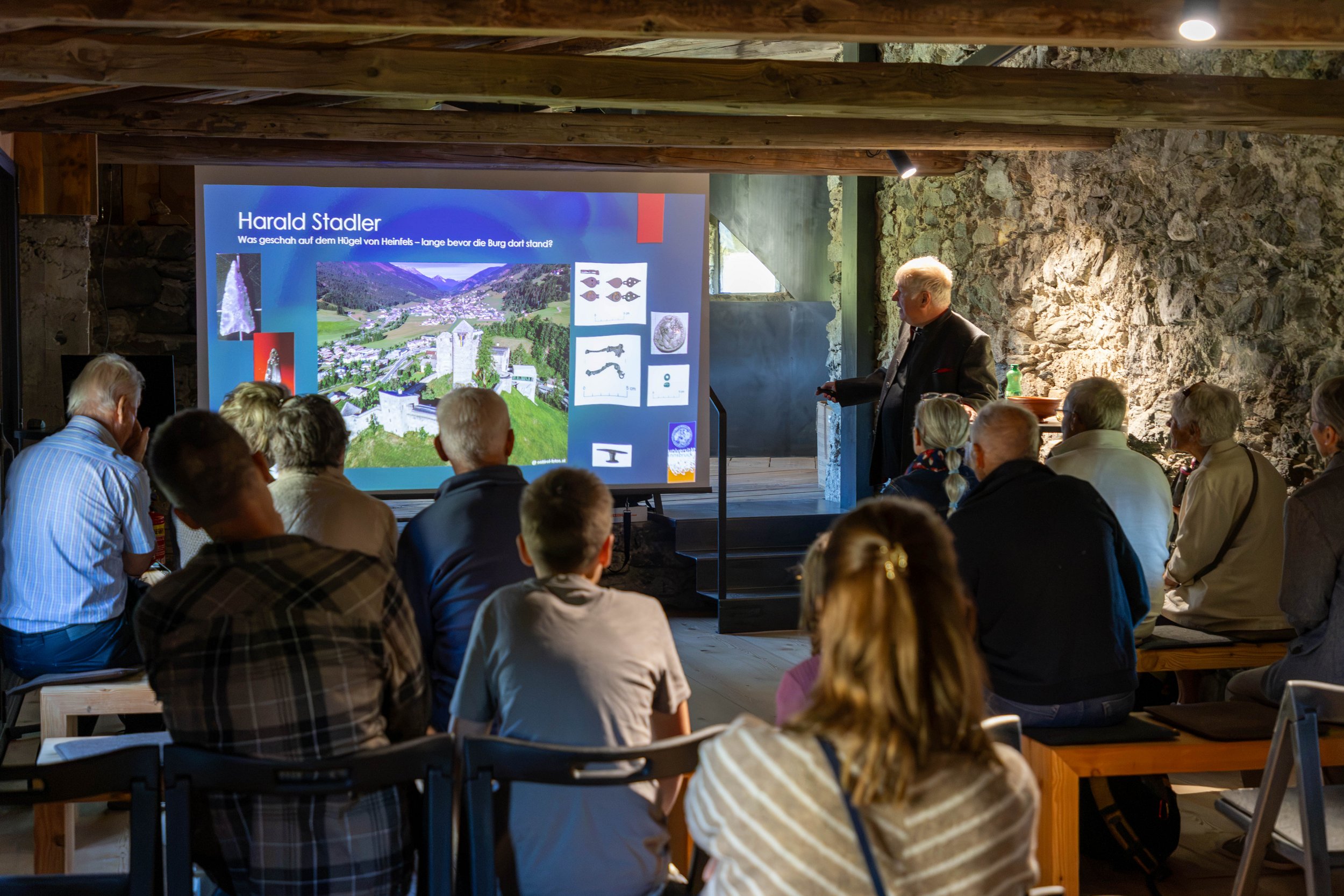
In an engaging presentation, Harald Stadler took the audience on a journey through the past.
The "Fortuna of Heinfels"
One particularly remarkable discovery is the now widely known "Fortuna of Heinfels". The approximately 12-centimetre-high Roman bronze statuette of the goddess Fortuna was discovered in 2021 by Lukas Kratzer during work on the northern side of the castle. The exceptionally well-preserved artefact was subsequently examined by experts at the University of Innsbruck.
Fortuna is considered one of the most outstanding Roman bronze finds made in East Tyrol in recent years. Its discovery has also raised new questions about how the castle hill was used during the Roman period. The statuette is intended to find its permanent home once again at Heinfels Castle in the future.
"There are still many stories to be told"
These recent discoveries clearly demonstrate that the archaeological history of Heinfels is far from complete. In his academic work, Harald Stadler highlights the considerable archaeological potential of the castle hill. Many areas have so far only been investigated selectively, while the undeveloped areas continue to offer opportunities for new insights into the prehistoric and early history of the region.
"There are still many stories to be told. In archaeology, every new discovery can bring a surprise – and sometimes even lead us to reassess what we thought we already knew."
For the Museumsverein Burg Heinfels, this provides an incentive to continue the archaeological exploration and organise further events in this format. Open Monument Day has impressively demonstrated one thing: the history of the castle began long before its walls were built.


